Peter Bichsel Fine Books
| Bild | Titel | Beschreibung | Kauf |
|---|---|---|---|

|
(Fischart, Johann, Pseud.:) Jesuwald Pickhart. Bienenkorb dess Heil(igen) Röm(ischen) Jm(m)enschwarms, seiner Hummelszellen (oder Himmelszellen) Hurnaussnäster, Brämengeschwürm unnd Wäspengetöss (...) Alles nach dem rechten Himmelstaw oder Manna justiert, und mit Mentzerkletten durchziert. |
Fischart, Johann. Bienenkorb dess Heil(igen) Röm(ischen) Jm(m)enschwarms, seiner Hummelszellen (oder Himmelszellen) Hurnaussnäster, Brämengeschwürm unnd Wäspengetöss (...) Alles nach dem rechten Himmelstaw oder Manna justiert, und mit Mentzerkletten durchziert.Titel in Rot und Schwarz. Mit Holzschnitt-Vignette auf dem Titel, 2 Holzschnitten im Text (1 davon wiederholte Titelvign.) und zahlr. Zierinitialen. (8), 272 (recte 273) Bll., (18) Bll. Register, 1 leeres Bl. 8vo. Pgt. d. Zt. mit 5 durchgezogenen Bünden. – Christlingen (d.i. Strassburg), Ursinus Gottgwinn (d.i. Bernhard Jobin, um 1595). Johann Fischarts (ca. 1545-1590) Übersetzung und mit zahlreichen eigenen Zusätzen versehene Bearbeitung der antirömischen Satire "Beyenkorf" (1574) des holländischen Calvinisten Philips van Marnix (pseud. Isaac Rabbotenu), Herrns von St. Aldegonde. Das satirische Pamphlet, mit dem sich Fischart, selbst Sympathisant der Calvinisten, gegen die katholische Restauration wandte, erschien erstmals 1579. Nach VD 16 liegt hier die dritte undatierte Ausgabe von ca. 1595 vor mit dem Wechsel von der vierten zur fünften Zeile nach dem in Klammer stehenden Wort “Himmelszellen”. "Der Bijnenkorf beruht auf einer gründlichen theologischen und historischen Gelehrsamkeit. In der Gesinnung angeregt durch Kalvin, in der Weltanschauung durch Erasmus, im Stil durch Rabelais. Die Fischartschen Zusätze umfassen ... etwa den sechsten Teil des Umfangs" (Neufforge). Fischarts antirömischem Engagement, für das der "Bienenkorb" eines der interessantesten literarischen Zeugnisse darstellt, wurde angesichts des grossen Einflusses des Jesuitenordens im Elsass allerdings kein grosser Erfolg zuteil. Die im Text wiederholte Titelvignette zeigt einen Bienenkorb in Form der päpstlichen Tiara. – VD 16 M 1055; STC, (German), 722 (unter Rabbotenu); Goedeke II, 499, 37k (Variante "hin-dern brennt"); Neufforge 112f. (gibt Erscheinungsdatum "nach 1618" an); Seebass/Edelmann II, 309; vgl. KNLL V, 575. Nicht bei Adams. – Durchgehend gebräunt. Titelblatt fast zur Gänze vom Bund gelöst. Das letzte leere Blatt mit hs. Eintrag des 18. Jhs. – Best.-Nr. 11340 |
CHF 840.— |
|
|
(Perottus, Nicolaus). In hoc volumine habentur haec. Cornucopiae, sive linguae latinae comentarii diligentissime recogniti: atq. ex archetypo emendati. (…). |
(Perottus, Nicolaus). In hoc volumine habentur haec. Cornucopiae, sive linguae latinae comentarii diligentissime recogniti: atq. ex archetypo emendati. (…).With woodcut printer’s device on title and repeated at the end of each part. 81 leaves, 1 blank leaf, 1436 cols., 15 leaves. Folio. Contemp. blind-tooled pigskin over four raised bands and wooden boards. – Venice, Aldus and Andreas Asulanus, 1526-1527. Fourth, enlarged edition published at Aldus. Collection of writings by different authors, first and foremost Nicolaus Perottus’ (1429–1480) „Cornucopiae“, a latin dictionary widely used in humanist circles in Europe. The additional content as listed on the title page: Index copiosissimus dictionum omnium (…); Eiusdem Sypontini libellus, quo Plynii epistola, ad Titum Vespasianum corrigitur; Cornelii Vitelij in eum ipsum Sypontini libellum annotationes; M. Terentij Varronis de lingua latina libri tres. Quartus. Quintus. Sextus; Eiusdem De analogia libri tres; Sexti Pompei Festi undeviginti librorum fragmenta; Nonii Marcelli Compendia, in quibus tertia ferè pars addita est (…), idque labore, & diligentia Iucundi nostri Veronensis, qui in Gallia Nonium cum antiquis contulit exemplaribus. Additus (…) longa dissertatio de generibus; Huc accedunt castigationes (…) Michaelis Bentini opera. The book was published in three parts, dated May 1526, September 1526, and March 1527. – Renouard 1834, 1; EDIT 16 CNCE 53685. – Pigskin torn on top end of spine, loose in several places and with some defects. Both pastedowns loose. Title page creased. Cancelled library stamp on verso of title page. Stain and defect to the inner joint in the rear part of the book. – Best.-Nr. 27062 |
CHF 1800.— |
|
|
(Piccolomini, Aenea Silvio al.) Pius II. Le histoire, costumi et successi della nobilissima provincia delli Boemi. |
(Piccolomini, Aenea Silvio al.) Pius II. Le histoire, costumi et successi della nobilissima provincia delli Boemi.With woodcut printer’s device on title. 110, (2) leaves. 12mo. Modern vellum with ms. spine title. – Vinegia (Venice, Bartholomeo Imperatore), 1545. First Italian translation of Enea Silvio Piccolomini’s (1405-1464; 1458 elected pope Pius II.) „Historia Bohemica“, first published in Rome in 1475. The author of this first translation of Piccolomini’s historic treatiese into a vernacular language is unknown. – EDIT 16 CNCE 40496. – Clean copy, rebound. – Best.-Nr. 27078 |
CHF 550.— |
|
Aesop. Aesopi Phrygis fabellae graece et latine, cum alijs opusculis, quorum index proxima refertur pagella. |
Aesop. Aesopi Phrygis fabellae graece et latine, cum alijs opusculis, quorum index proxima refertur pagella.Mit Druckermarke in Holzschnitt auf dem Titel und auf dem letzten Blatt verso und drei Holzschnitt-Initialen zu Beginn. 364, (2) Bll. Kl.-4to. Blindgepr. Schweinsldr. über Holzdeckeln und drei Bünden. – Basel, (Johannes Frobenius, Februar) 1524. Frühe griechisch-lateinische Parallelausgabe, der dritte griechische Druck von Aesops Fabeln bei Froben, mit einem Vorwort von ihm als Herausgeber an die „studiosi“. Enthält zusätzlich Fabeltexte von Babrius (hier: Gabrius), Aphthonius, Homer, Musaeus, Agapetus u.a. – VD16 A 416: Adams A-280; IA 101.035; Hieronymus, Griechischer Geist, Nr. 159. – (Angebunden:) Euripides. Euripidis tragoediae duae, Hecuba et Iphigenia in Aulide, latinae factae, Des. Erasmo Roterodamo interprete. Mit Druckermarke in Holzschnitt auf dem Titel und auf dem letzten Blatt verso und einigen Holzschnitt-Initialen. (140) Bll. Basel, Johannes Frobenius, 1524. Erster zweisprachiger Druck von Tragödien des Euripides. Erasmus’ Übersetzung aus dem Griechischen, die erste von Tragödien des Euripides überhaupt, war erstmals 1506 in Paris erschienen, 1518 erstmals in Basel. Die Widmungsvorrede Erasmus’ ist an William Warham, Erzbischof von Canterbury und Primus der Kirche in England, gerichtet. – VD16 E 4230; Hieronymus, Griechischer Geist, Nr. 193; Vander Haeghen II, 25. – Die erste Lage mit abegriffener Stelle am Aussensteg. Ausführliche zeitgenöss. Notiz auf vorderem Innendeckel. Zwei alte hs. Besitzeinträge auf dem Titel, vereinzelte Marginalien von zeitgenöss. Hand. Schliessen fehlen. Insgesamt schönes, sauberes Exemplar in zeitgenöss. Einband – Best.-Nr. 27039 |
CHF 2800.— | |
|
|
Aethicus Ister. Aethici Cosmographia. Antonii Augusti itinerarium provinciarum. Ex Bibliotheca P. Pithoei, cum scholiis Iosiae Simleri. |
Aethicus Ister. Aethici Cosmographia. Antonii Augusti itinerarium provinciarum. Ex Bibliotheca P. Pithoei, cum scholiis Iosiae Simleri.Mit Druckermarke auf dem Titel. (16) Bll., 353, (1) SS., (67) Bll. 16mo. Flexibles Pgt. d. Zt. mit hs. Rückenschild. – Basel, (Thomas Guarinus), 1575. Sammlung von antiken Reisebeschreibungen, herausgegeben und kommentiert vom Zürcher Historiker und Theologen Josias Simler (1530-1576). Simler war der erste, der dem ersten, aus dem 7. oder 8. Jahrhundert stammenden Text der Sammlung und damit dieser selbst den Titel „Aethici Cosmographia“ gab und dabei den Protagonisten Aethicus aus Istrien zum Autor hochstilisierte. Die anderen enthaltenen Texte sind: „Itinerarium provinciarum“ des Antoninus Augustus Pius, ein „Itinerarium“ des Claudius Rutilius Namatianus und das „Liber de fluminibus, fontibus, lacubus, montibus, etc.“ des Sequester Vibius. Exemplar aus dem Besitz des Zuger Ratsherrn und Sammlers Paul Anton Wickart (1760–1832) mit dessen Exlibris auf hinterem Innendeckel. Die Wickartsche Sammlung wurde nach dem Tod seines Enkels Franz (1857–1917) aufgelöst. – VD16 A 569. – Zwei Lagen inkorrekt gebunden. Vorsatz rissig und mit alten hs. Notizen. Durchgehend etwas feuchtigkeitsfleckig. Schliessbänder fehlen. – Best.-Nr. 27104 |
CHF 480.— |
|
Agricola (i.e. Meyer), Daniel. Passio domini nostri Jesu christi secundum seriem quattuor evangelistarum. |
Agricola (i.e. Meyer), Daniel. Passio domini nostri Jesu christi secundum seriem quattuor evangelistarum.With nearly full-page woodcut title vignette and 20 woodcut vignettes in the text (3 monogr.), all by Urs Graf. 39, (1) leaves. Small 4to. Boards covered with an old manuscript leaf and painted black. Spine made of blind-stamped pigskin, monogrammed „T.V.K.“ and dated 1580 on front board. – Basel, (Johannes Frobenius), 1512. Daniel Meyer’s (Franciscan, c. 1490–1540, Latinized as Agricola) “Passio” was written as a second part of the “Postilla” by Guilelmus Parisiensis (1437–1485). It bears its own title and colophon and was – like in the present case – also published separately. Guilelmus’ “Postilla” had already been printed in 1509 and 1511 by Adam Petri. The present separate edition of the “Passio” by Johannes Froben features the large title woodcut designed by Urs Graf, which had already been used by Petri in 1509. The woodcut depicts Jesus preaching in the center, surrounded by the four Evangelists’ symbols eagle, bull, angel, and lion, the prophet Daniel, and the apostles Petrus, Paulus, and Jacobus. Froben changed the typographic captions within the image, as well as the year of printing inserted above the eagle. – VD16 E 4383; Petri–Schwabe No. 21a and in detail p. 66. – Contemp. notes on title page next to the woodcut and on verso. A few small, continuous wormholes that barely interfere with the text. – Best.-Nr. 27027 |
CHF 4500.— | |
|
Ambrosius von Mailand. (Omnia opera denuo accuratissime revisa et noviter impressa). Pars prima operum. Teil I (von 3). |
Ambrosius von Mailand. (Omnia opera denuo accuratissime revisa et noviter impressa). Pars prima operum. Teil I (von 3).Mit einigen rot und blau eingemalten Initialen. 6 (statt 8) unn. Bll., 275 (recte 273) num. Bll., 1 unn. Bl. 4to. Broschur. – (Basel, Johannes Petri de Langendorf, Mai 1506). Der erste von drei 1506 bei Petri in Basel erschienenen Teile der „Opera omnia“ des Mailänder Bischofs Ambrosius (339–337), der seit 1295 als einer der vier grossen Kirchenväter verehrt wird und Heiligenstatus hat. Dem vorliegenden ersten Teil vorangestellt ist die Vita des Ambrosius, verfasst von Paulinus, Patriarch von Antiochia. Eingeleitet werden die Werke mit einem Brief an die Leser des Maulbronner Zisterziensermönchs Conrad Leontorius (ca. 1465–1511), der diese zweite Gesamtausgabe als Herausgeber verantwortet. Sie ist nach der Ausgabe bei Johannes Amerbach von 1492 erst der zweite Druck von Ambrosius’ Werken überhaupt, zudem ist sie der erste Druck, den Johannes Petri als Drucker alleine verantwortet. Im einleitenden Brief zum ersten Teil lobt Leontorius Basel seines hoch angesehenen Buchdruckgewerbes wegen, das jetzt eine zweite Gesamtausgabe von Ambrosius’ Werken hervorbringe, diesmal in kleinerem Format und zu günstigerem Preis. – VD16 A 2177; STC, (German), 25 (ebenfalls nur Teil I); Petri–Schwabe Nr. 14 (ausführlich). – Die erste, die „Vita“ enthaltende Lage ohne das Titelblatt mit Holzschnitt und ohne das leere Blatt a8. Ohne die 104 Bll. Register zum Teil I. – Best.-Nr. 27067 |
CHF 1800.— | |
|
Aretino, Pietro. La Prima Parte de Ragionamenti di M. Pietro Aretino cognominato il Flagello de Prencipi, il Veritiero, e il Divino […]. – (AND:) La seconda Parte de Ragionamenti […]. – (AND:) Commento de Ser Agresto da Ficaruolo Sopra la Prima Ficata del Padre Siceo. Con la Diceria de Nasi. 3 part in 1. |
Aretino, Pietro. La Prima Parte de Ragionamenti di M. Pietro Aretino cognominato il Flagello de Prencipi, il Veritiero, e il Divino […]. – (AND:) La seconda Parte de Ragionamenti […]. – (AND:) Commento de Ser Agresto da Ficaruolo Sopra la Prima Ficata del Padre Siceo. Con la Diceria de Nasi. 3 part in 1.(12), 219, (1) pp.; (6), 373, (5) pp.; (12), 116 pp.. Small 8vo. Full black marocco with gilt ornamentation on spine, front and back board. With red spine label. – Bengodi (i. e. London), (John Wolfe), 1584. This edition of Pietro Aretino’s (1492–1556) most famous œuvre „Ragionamenti“, contains the first and second part of the „Ragionamenti“, including the „Ragionamento del Zoppino“, which most likely was not written by Aretino himself. The original text was published in 1534 and 1536 in Venice and Turin. Printed under the false name „Il Barbagrigia“ and the fictictious location Bengodi, John Wolfe (1547–1601) tried to escape the bad reputation of books printed in England in foreign languages at the time. Wolfe’s edition of the „Ragionamenti“ was a huge success and five line-for-line reprints were published before 1600 by various printers. – CNCE 2482; Woodfield 44; Woodfield 45. – Spine and extremities rubbed, beautiful copy in all. – Best.-Nr. 26413 |
CHF 2800.— | |

|
Aristoteles. Politicorum ad Nicomachum lib(er) primus Raphaelis Volaterrani argumenta in eosdem Leonardo Aretino interprete. |
Aristoteles. Politicorum ad Nicomachum lib(er) primus Raphaelis Volaterrani argumenta in eosdem Leonardo Aretino interprete.With woodcut printer’s device on title. 195, (1) leaves. Small 8vo. Modern full calf over 4 raised bands. – Venetijs (Venice), Hieronymus Scotus, 1542 (at the end: 1543). Authoritative Venice edition of the eight book of Politics by the Greek philosopher Aristotle (384–322 B.C.) with the comments by the Italian Renaissance Raffaele Maffei da Volterra (1451–1522). The translation is the one by Leonardo Bruni (Aretino, 1369–1444). – Title leaf with old owner’s inscription, paper restoring to lower portion of leaf. Leaf K4 bound before leaf K3. Good and mostly clean copy in am appropriate recent binding. – Best.-Nr. 19981 |
CHF 1200.— |
|
|
Aristoteles. Organi Graecolatini pars posterior in qua topica et sophistici elenchi continentur (= Graecolatini Aristotelis Asclepiadae Stagiritae Organi, sive instrumenti instrumentorum, aut Philosophiae manus, Bd. II von 2). |
Aristoteles. Organi Graecolatini pars posterior in qua topica et sophistici elenchi continentur (= Graecolatini Aristotelis Asclepiadae Stagiritae Organi, sive instrumenti instrumentorum, aut Philosophiae manus, Bd. II von 2).Mit Druckermarke in Holzschnitt auf Titel und zahlreichen Holzschnitt-Initialen. (2) SS., SS. 807-1433, 60 unn. Bll. Register. 8vo. Pgt. d. Zt. mit hs. Rückentitel. – Basel, (Johannes Oporinus, Januar 1573). Zweiter Teil der zweiten Organon-Ausgabe aus der Druckerei von Johannes Oporinus mit griechisch-lateinischen Paralleltext. Der vorliegende Band enthält die Topik, die Sophistischen Widerlegungen und das Register. Herausgegeben, übersetzt und mit einem Vorwort versehen von Johannes Hospinianus (1515–1575), Professor für Griechisch und Rhetorik sowie später Ordinarius für Logik an der Universität Basel. Die erste bei Oporinus erschienene Organon-Ausgabe enthielt nur den griechischen Text ohne lateinische Übersetzung und erschien 1564. Exemplar aus der Bibliothek des Frauenfelder Pfarrers Georg Alfred Kappeler (1839–1916) mit dessen Exlibris auf hinterem Innendeckel. – VD16 A 3523; Hieronymus, Griech. Geist, 120. – Titelseite unten ohne Textverlust beschnitten. Vorsatzblatt entfernt. Ausführliche „Synopsis“ von sorgfältiger zeitgenöss. Hand auf dem Innendeckel. Stellenweise etwas fleckig. – Best.-Nr. 27024 |
CHF 450.— |
|
Bizarus, Petrus. Pannonicum bellum, sub Maximiliano II. Rom. et Solymano turcar(um) imperatoribus gestum: cumque arcis sigethi expugnatione, iampridem magna cura et studio, descriptum. Unà, Cum Epitome illarum rerum quae in Europa insigniores gestae sunt: et praesertim de Belgarum motibus, ab anno LXIIII. usque ad LXXIII. |
Bizarus, Petrus. Pannonicum bellum, sub Maximiliano II. Rom. et Solymano turcar(um) imperatoribus gestum: cumque arcis sigethi expugnatione, iampridem magna cura et studio, descriptum. Unà, Cum Epitome illarum rerum quae in Europa insigniores gestae sunt: et praesertim de Belgarum motibus, ab anno LXIIII. usque ad LXXIII.With woodcut printer’s device at the end of the text part and before the index. (8) leaves, 322 (recte 332), (4) pp., (56) pp. index, last leaf blank. Small 8vo. 18th-century full vellum on three bands with ms. spine title. – Basel, Sebastianus Henricpetri, (1573). First Latin edition of Pietro Bizzarri’s (1525-1586) account of the Turkish war in Hungary from 1540 to 1547. Italian editions were first published in 1568 and 1569 in Lyons, and it was Bizzarri himself which translated it into Latin in order to reach a larger public. The dedication at the beginning is adressed to the 13 years old Christian of Saxony, son of Prince Elector August. It is dated january 1573 and gives the young man a brief account of the history of writing and of historiography. The Turkish war in Hungary (pp. 1–165) is followed by an account of the unrest in the Netherlands in 1566 and of other contemporary European occurencies (pp. 166–332). The present single imprint of Bizzari’s “Pannonicum bellum” was one month later compiled in a collective edition together with the Latin translation “Aula Turcicae” of Antoine Geuffroy’s “Briefve description de la cour du grand Turc” and with the “Belli Cyprij inter Venetos et Zelymum Turcarum Imp.” as well by Bizzarri. – VD 16 B 5758 (single edition) and G 1913 (collective edition); STC, (German), 128; Petri-Schwabe Nr. 526. – Very clean copy in a cultivated vellum binding. – Best.-Nr. 16552 |
CHF 2100.— | |
|
Blarer, Bartholomaeus. Repetitio solemnis. L. Diffamari Cod. de Ingen(uis) manumiss(is). Ioh(annis) Oldendorpii in eandem l(egem) commentatio. |
Blarer, Bartholomaeus. Repetitio solemnis. L. Diffamari Cod. de Ingen(uis) manumiss(is). Ioh(annis) Oldendorpii in eandem l(egem) commentatio.Mit Druckermarke in Holzschnitt auf dem Titel und am Schluss. (16) Bll., 392 SS., (20) Bll. 8vo. Flexibles Pgt. mit vier durchgezogenen Bünden, Schliessbändern und hs. Rückentitel. – Basel, Officina Episcopiana (per Eusebium Episcopum et Nicolai fratris haeredes), 1579. Zweite Ausgabe (erste Ausg. Basel 1563) von Bartholomäus Blarers Schrift zur Verteidigung des Römischen Rechts mit Zueignungsschrift an Herzog Christoph von Württemberg. Exemplar aus dem Besitz des Frankfurter Juristen Johann von Fichard (1512–1581) mit dessen eigenh. Besitzeintrag „Ex bibliotheca Johannis Fichardi j.c.“ auf dem Titelblatt. In seiner Schrift vertritt Blarer die Meinung, dass der Zustand des deutschen Reiches sich nicht bessern werde, solange das Römische Recht nicht vermehrt studiert und angewendet werde. Auf Blarers Abhandlung folgt ein Kommentar des norddeutschen Juristen Johann Oldendorp (1488–1567) sowie ein ausführliches alphabetisches Register. Wie Blarer setzte sich auch Fichard für die verstärkte Orientierung der uneinheitlichen deutschen Rechtssprechung am Römischen Recht ein. – VD16 B 5674; ADB II, 693 (Blarer). – Zweiter, jüngerer und teilweise gelöschter hs. Besitzeintrag auf dem Titel. Unleserlicher Bibliotheksstempel auf fliegendem Blatt. Schönes, sauberes Exemplar in zeitgenöss. Einband, von interessanter Provenienz. – Best.-Nr. 27046 |
CHF 950.— | |
|
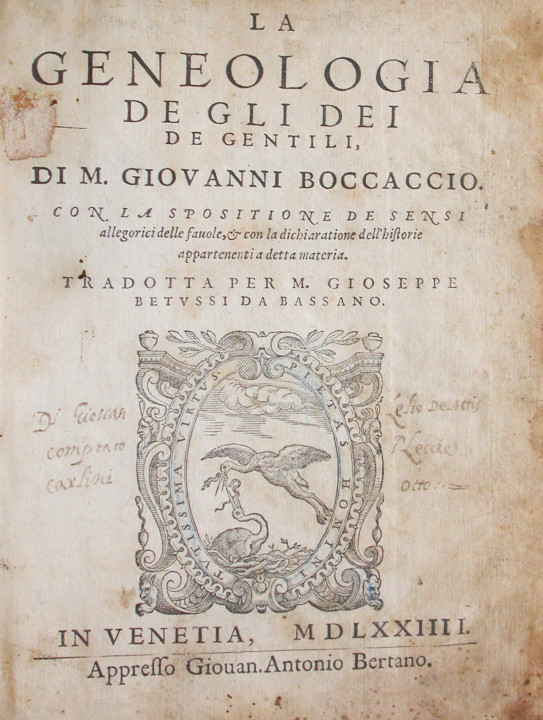
Boccaccio, Giovanni. La genealogia de gli dei de gentili. Con la spositione de sensi allegorici delle favole, et con la dichiaratione dell’historie appartenenti a detta materia. Tradotta per M. Gioseppe Betussi da Bassano. |
Boccaccio, Giovanni. La genealogia de gli dei de gentili. Con la spositione de sensi allegorici delle favole, et con la dichiaratione dell’historie appartenenti a detta materia. Tradotta per M. Gioseppe Betussi da Bassano.With woodcut printer’s device. (8), 263 leaves. Small 4to. Contemp. vellum. – Venetia, Giovan. Antonio Bertano, 1574. Probably the fifth Italian edition of Boccacio’s genealogy of the pagan gods and his interpretation of antique mythology, one of the first documents of Humanism. Italian translation by Giuseppe Betussi (1512–1573). – Cf. Adams B 2175–76; Brunet I, 986. – Title leaf browned and with old onwer’s inscription. Last two quires browned affected by a heavier brown spot on upper margin. Last leaf with reinforced outer margin. Good in all. – Best.-Nr. 19997 |
CHF 1200.— |
|
|
Brederode, Peter Corn(elis van), Hrsg. Analysis [griech.] seu resolutio dialectica quatuor librorum institutionum imperialum. |
Brederode, Peter Corn(elis van), Hrsg. Analysis [griech.] seu resolutio dialectica quatuor librorum institutionum imperialum.Mit Druckermarke auf Titel und ganzs. Stammbaum-Modell in Holzschnitt. (12), 588, (38) SS. 8vo. Pgt. d. Zt. mit hs. Rückentitel. – (Strassburg), Theodosius Rihel, (1593). Überarbeitete Fassung von Ludwig Gemp von Freudensteins (1509–1583) umfangreichen Kommentar über die Institutiones Iustiniani. Gemps Text erschien erstmals 1567 beim Strassburger Drucker Samuel Emmel und wurde 1569 von Rihel wiederabgedruckt, noch unter der Nennung Gemps auf der Titelseite. Der Jurist Pieter Cornelis van Brederode (1559–1637) hat Gemps Text weitestgehend übernommen für die vorliegende Ausgabe und auf eine Nennung von Gemp verzichtet. 1593 erschien neben der vorliegenden Ausgabe ein weiterer Abdruck bei Rihel mit identischen Titel, aber geringerem Seitenumfang. – VD16 B 7388; Index Aurel. 124.171. – Titelblatt mit Ausriss und wenig Buchstabenverlust. Laienhaft koloriert, zudem mit hist. Besitzeinträgen. Text mit hs. Unterstreichungen und Marginalglossen. – Best.-Nr. 27031 |
CHF 280.— |
|
|
Cardianus, Hieronymus. Proxeneta, seu de prudentia civli liber; Recens in Lucem protractus vel e tenebris erutus. |
Cardianus, Hieronymus. Proxeneta, seu de prudentia civli liber; Recens in Lucem protractus vel e tenebris erutus.With engr. title. (24), 767 pp. 16mo. Contemp. vellum. – Lugdunum Batavorum (Leiden), Officina Elzeviriana, 1627. First edition. Posthumously published writings by the Italian Renaissance physician and philosopher Gerolamo Cardiano (1501–1576). Re-published by Elzevier in 1635 unter the title „Arcana politica“. – Willems 272. – Ties lacking. Defect to lower margin of front board affecting the margin first 24 unnumbered leaves. White upper and lower margins of engr. title cut off. – Best.-Nr. 23247 |
CHF 530.— |
|
|
Carion, Johann. Chronica, vleissig zusamen gezogen, meniglich nützlich zulesen. Sampt einem Register […] Volstreckung dieser Chronica, vom 32. Jar der mindern zal, bis ins 46. (durch Johann Funck). |
Carion, Johann. Chronica, vleissig zusamen gezogen, meniglich nützlich zulesen. Sampt einem Register […] Volstreckung dieser Chronica, vom 32. Jar der mindern zal, bis ins 46. (durch Johann Funck).244 (recte 245) Bll., 1 Bl. Impressum, 2 leere Bll., (14) Bll. Register. Kl.-8vo. Blindgepr. Kalbldr. über 3 Bünden (Kapitale defekt, Bünde offen, Kanten berieben, Schliessen fehlen). – Wittenberg, Georg Rau, 1546. Von Johann Funck (1518–1566) bis auf Luthers Todesjahr 1546 fortgeführte Wittenberger Ausgabe der 1532 erstmals von Melanchthon herausgegebenen Chronik des Hofastrologen Joachims I. von Brandenburg, Johann Carion (1499–1538). Carions Chronik erlebte zahlreiche Nachdrucke mit Fortführungen, wurde in viele Sprachen übersetzt, so ebenfalls im Jahr 1546 von Melanchthon ins Lateinische. – VD 16 C 1004. – Blatt X4 mit restauriertem Einriss, die letzte Lage neu fixiert. Durchgehend etwas gebräunt und fleckig. Innendeckel mit alten hs. Notizen. Insgesamt gutes Exemplar in zeitgen. Renaissance-Einband. – Best.-Nr. 12661 |
CHF 1000.— |
|
|
Carion, Johann. Chronica. Jetz von newem ubersehen, und an vilen orten, da bissher durch mannicherley Truck, etwa mängel eingeschlichen, nach notturfft Corrigiert. (…) Jetzt erstlich in Truck gegeben. Durch Michaelem Beuther von Carlstatt, der Rechten Doctorn. |
Carion, Johann. Chronica. Jetz von newem ubersehen, und an vilen orten, da bissher durch mannicherley Truck, etwa mängel eingeschlichen, nach notturfft Corrigiert. (…) Jetzt erstlich in Truck gegeben. Durch Michaelem Beuther von Carlstatt, der Rechten Doctorn.Titel in Rot und Schwarz. (12), 335, (1) Bll. 8vo. Blindgepr. Schweinsldr. d. Zt. über Holzdeckeln und 3 Bünden, eine von zwei Metallschliessen vorhanden. – Frankfurt am Main, David Zöpfel für Michael Beuther, 1564 (im Kolophon: 1563). Erste Ausgabe der von Michael Beuther (1522–1587) überbearbeiteten Fassung von Johann Carions (1499–1537) Chronik. Zu Beuthers wichtigsten Förderern gehörte Philipp Melanchthon (1497–1560), der seinerseits bedeutenden Einfluss auf die Entstehung der Chronik hatte und Beuther bei Martin Luther einführte. Der Bericht endet mit der Sichtung des Kometen im Jahr 1532. – VD16 ZV 2949. – Vorderes Innengelenk locker. Hist. Besitzeinträge auf Vorsatz und Titel sowie Anstreichungen im Text. Innen stellenweise angeschmutz und fleckig. – Best.-Nr. 27030 |
CHF 850.— |
|
|
Carion, Johann u. Philipp Melanchthon. Prima Pars Chronici Carionis Latine expositi et aucti multis & veteribus & recentibus Historijs, in narrationibus rerum Graecarum, Germanicarum et Ecclesiasticarum – (Und:) Secunda pars Chronici Carionis ab Augusto Caesare usque ad Carolum Magnum. 3 Bücher in 2 Teilen in 1 Bd. |
Carion, Johann u. Philipp Melanchthon. Prima Pars Chronici Carionis Latine expositi et aucti multis & veteribus & recentibus Historijs, in narrationibus rerum Graecarum, Germanicarum et Ecclesiasticarum – (Und:) Secunda pars Chronici Carionis ab Augusto Caesare usque ad Carolum Magnum. 3 Bücher in 2 Teilen in 1 Bd.Mit Porträtmedaillon Melanchthons in Holzschnitt auf Titelblatt von Teil 1 und Holzschnittdruckermarke auf Titelblatt von Teil 2. (12), 190, (14) Bll.; (8), 192, (16) Bll. Kl.-8vo. Schweinsldr. mit Platten- und Rollenstempel über drei Bünden mit hs. Rückenschild. Vorderdeckel mit Monogramm „M.W.S“ und datiert 1562. – Wittenberg, Georg Rhau Erben, 1562 (Tl. I) resp. 1561 (Tl. II). Von Caspar Peucer besorgte Neuausgabe der auf Johann Carion zurückgehenden und von Philipp Melanchthon erweiterten Weltchronik. Der Astrologe, Mathematiker und Historiker Johann Carion (1499–1537) verfasste zu Beginn der 1530er-Jahre eine Chronik, die vielfach auf Deutsch und in einer Übersetzung von Hermann Bonnus auch auf Latein erschien. Nach Carions Tod überarbeitete Philipp Melanchthon (1497–1560) den Text und gab ihn neu heraus. Nach Melanchthons Tod übernahm dessen Schwiegersohn Caspar Peucer (1525–1602) die Herausgeberschaft der Chronik, zu der er 1569 einen dritten Teil erscheinen liess. Der mit „M. W. S.“ monogrammierte und 1562 datierte, mit Platten- und Rollenstempel verzierte Einband zeigt auf der Vorderseite die Justitia, unterlegt von einer dreizeiligen Legende „Iusticie quisquis picturam lumine cernis dic deus est Iustus Iustao“. Auf der Rückseite figuriert Lucretia mit dem Dolch, darunter die dreizeilige Legende „Casta tulit magna formae Lucretia laude actat mages“ – VD16 M 2706 (Tl. II) und M 2707 (Tl. I). – Ecken bestossen, Einband und Inhalt stellenweise leicht fleckig. Ausführliche zeitgen. hs. Notizen auf vorderem Vorsatz. Hs. Eigentumsvermerk „Sulzer 1822“ auf dem Titelblatt und dem fliegenden Blatt verso. – Best.-Nr. 25351 |
CHF 850.— |
|
|
Cicero, (Marcus Tullius). Le epistole famig(liari) di Cicerone, tradotte secondo i veri sensi dell’auttore, e con figure proprie della lingua volgare, ristampate, & con molto studio rivedute, & corrette. |
Cicero, (Marcus Tullius). Le epistole famig(liari) di Cicerone, tradotte secondo i veri sensi dell’auttore, e con figure proprie della lingua volgare, ristampate, & con molto studio rivedute, & corrette.With printer’s device on title page and last flyleaf. (1), 305, (1) leaves. 8vo. Contemp. vellum with ms. spine title. – Venice, Aldus, 1545. Second, corrected edition of the first Italian translation of Cicero's “Epistulae ad familiares” published by Aldus. The first edition was published in the same year. The two editions differ in page count and representation of the year, which appears unusually as M. D. XXXXV. on the title page of the present copy. – Renouard 1834, 9; EDIT16 CNCE 12265. – Spine with defect, paste-downs loose. Title and first leaf with damp stain to lower edge, the last four leaves stained. Hist. writing on first flyleaf. – Best.-Nr. 27028 |
CHF 680.— |
|
|
Cicero, Marcus Tullius. Rhetorica, tradotta di latino in lingua Toscana, per Antonio Brucioli e di novo ristampata con la tavola. |
Cicero, Marcus Tullius. Rhetorica, tradotta di latino in lingua Toscana, per Antonio Brucioli e di novo ristampata con la tavola.Title within woodcut border. 84 leaves. 12mo. Somewhat later full vellum with gilt-ornated spine. – Venice, Gabriele Iolito di Ferrarii, 1542. Italian translation of Cicero’s „Rhetorica ad Herennium“ by the Italian Humanist Antonio Brucioli (1498-1566), famous for his Italian translation of the bible, which was put on the index of the forbidden books by Pope Paul IV. – Clean copy. – Best.-Nr. 27084 |
CHF 450.— |
|
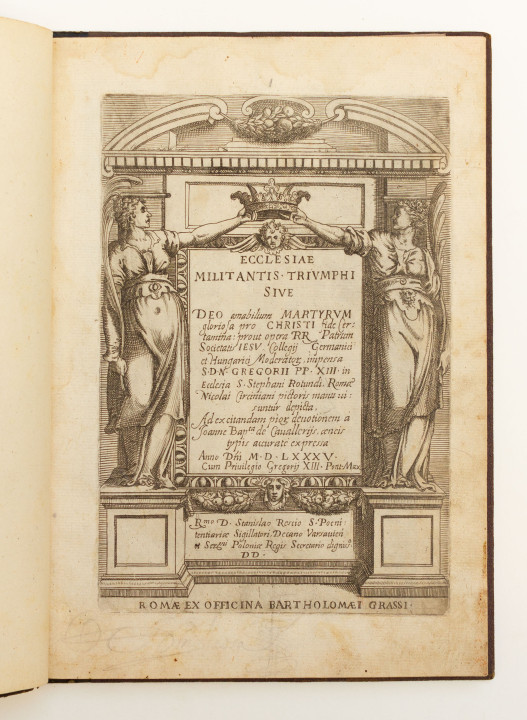
Circignani, Niccoló and Giovanni Battista Cavalieri. Ecclesiae militantis triumphi sive Deo amabilium martyrum gloriosa pro Christi fide certamina: prout opera RR Patrum Societatis Iesu Collegij Germanici et Hungarici moderator impensa S. D. N. Gregorii PP. XIII. in Ecclesia S. Stephani Rotundi. – (And:) Ecclesiae Anglicanae Trophaea sive Sanctorum Martyrum qui pro Christo Catholicaeque fidei Veritate asserenda antiquo recentiorique persecutionum tempore mortem in Anglia subierunt, Passiones. 2 parts in 1 vol. |
Circignani, Niccoló and Giovanni Battista Cavalieri. Ecclesiae militantis triumphi sive Deo amabilium martyrum gloriosa pro Christi fide certamina: prout opera RR Patrum Societatis Iesu Collegij Germanici et Hungarici moderator impensa S. D. N. Gregorii PP. XIII. in Ecclesia S. Stephani Rotundi. – (And:) Ecclesiae Anglicanae Trophaea sive Sanctorum Martyrum qui pro Christo Catholicaeque fidei Veritate asserenda antiquo recentiorique persecutionum tempore mortem in Anglia subierunt, Passiones. 2 parts in 1 vol.Suites of 31 and 35 engr. plates, each with an engr. title page by Giovanni Battista de Cavallieri. 68 leaves in all. Small folio. Half calf of the 19th century. Gilt spine title. – Rom, Bartolomeo Grassi, 1585 (part I) resp. 1584 (part II). Complete run of the two-part martyrology by the Italian Mannerist Niccolò Circignani (c. 1530–1595, known as il Pomarancio), with the first part appearing in the second edition (initially published in 1583). In 1582/83, Circignani executed a cycle of martyrs in the Church of Santo Stefano Rotondo on commission from Pope Gregory XIII, followed by a second cycle in the Anglican collegiate church of San Tommaso di Canterbury. Immediately after the completion of the two fresco cycles, the engraver Giovanni Battista Cavalieri (1525–1601) captured them in the present copperplate engravings and provided them with brief, explanatory captions. Cavalieri’s rendering of Circignani’s martyr cycles contributed significantly to the iconographic support for the Counter-Reformation. – Cicognara 2008; Brunet I, 1697. – The edges of the pages slightly stained throughout. The odd-numbered pages (3, 5, 7, etc.) in Part II were professionally repaired most likely during the 19th-century rebinding. – Best.-Nr. 24136 |
CHF 6800.— |
|
|
Cucharo, Antonio de. Elucidarius virginis. De conceptione incontaminata virginis gloriose. |
Cucharo, Antonio de. Elucidarius virginis. De conceptione incontaminata virginis gloriose.Printed in 2 cols. (660) pp. 4to. 18th-century full vellum with spine label. – Neapoli (Naples), Johannes Antonius de Caneto, 24. Mai 1507. First and only edition of Antonius de Cucharo’s (OFM, active around 1500) tract on the immaculate conception of the Virgin Mary. – Ex library copy with shelfmark and perforation stamp on title leaf, perforation stamp repeated on last text leaf. Some worm traces and some small old ms. marginal drawings. Clean in all. – Best.-Nr. 20016 |
CHF 2500.— |
|
Demosthenes. Demosthenis et Aeschinis orationes atque epistolae, quae ad nostram aetatem pervenerunt, omnes (...): Per Hieronymum Wolfium Oetingensem. 4 Tle. in 2 Bden. |
Demosthenes. Demosthenis et Aeschinis orationes atque epistolae, quae ad nostram aetatem pervenerunt, omnes (...): Per Hieronymum Wolfium Oetingensem. 4 Tle. in 2 Bden.(24) Bll., 347 SS., Spp. 348–513. SS. 514–523; 326 SS.; 324, (16) SS.; 335 SS. 8vo. Blindgepr. Kalbldr. d. Zt. über 3 Bünden mit ehemals goldgepr. Deckelornamentik und Resten von hs. Rückenschild. – Basel, Johannes Oporinus, (1554). Oktav-Ausgabe der vier Jahre zuvor ebenfalls bei Oporin in folio erschienenen Demosthenes-Übersetzung des in Oettingen geborenen Humanisten Hieronymus Wolf (1516–1580), der ab 1551 als Sekretär und Bibliothekar bei Johann Jakob Fugger in Augsburg tätig war, an den sich die mit 1553 datierte Widmungsvorrede im ersten Teil richtet. Die nur der Oktav-Ausgabe beigegebenen Reden des Aeschines sind von Wolf hier zum ersten Mal in lateinischer Übersetzung in den Druck gegeben worden und funktionieren beispielhaft als Gegenreden zu Demosthenes. – VD16 D 488; Adams D 270; Hieronymus, Griechischer Geist, Nr. 227 (sehr ausführlich). – Kleiner Wurmgang am Fussteg zu Beginn von Teil I. Schliessbänder fehlen. Saubere Bände in zeitgenöss. Einband – Best.-Nr. 27051 |
CHF 1600.— | |
|
Dinoth, Richard. Adversaria historica. In Centurias, Quinquagenarias, Decurias et ataktous (griech. Lettern) digesta. |
Dinoth, Richard. Adversaria historica. In Centurias, Quinquagenarias, Decurias et ataktous (griech. Lettern) digesta.Mit Holzschnitt-Druckermarke auf dem Titel und einigen Holzschnitt-Initialen. (4) Bll., 392 SS. Kl.-4to. Flexibles Pgt. d. Zt. mit sechs durchgezogenen Bünden. – Basel, Petrus Perna, 1581. Erste Ausgabe. Der französische Protestant Richard Dinoth (1540–1586) hielt sich 1570/71 in Basel auf, wo er in den Matrikeln der Universität bezeugt ist. 1574 flüchtete er nach Montbéliard, wo er als evangelischer Pfarrer wirkte. Seine historischen Schriften erschienen allesamt zwischen 1580 und 1586 bei Perna in Basel. – VD16 D 1773. – Kleines Doublettenstempelchen und alte Besitzeinträge auf fliegendem Blatt. Durchgehender Feuchtigkeitsfleck am Fusssteg, insgesamt jedoch schönes und sauberes Exemplar in zeitgenöss. Einband. Schliessbänder fehlen. – Best.-Nr. 27044 |
CHF 880.— | |
|
|
Erasmus (Roterodamus), D(esiderius). Adagiorum epitome. Ex novissima Chiliadum recognitione excerpta. |
Erasmus Roterodamus, Desiderius. Adagiorum epitome. Ex novissima Chiliadum recognitione excerpta.Mit Holzschnitt-Druckermarken auf dem Titelblatt und auf der zweitletzten Seite verso. 536, (72) SS. 8vo. Blingepr. Schweinslederband d. Zt. über Holzdeckeln und drei Bünden mit hs. Rückenschild. – Lyon, Seb. Gryphius, 1544. Lyoner Ausgabe von Erasmus’ (gest. 1536) „Adagia“, seiner kommentierten Sammlung antiker Sprichwörter und Redewendungen. Die Ausgabe wird von einem Vorwort Gryphius’ eingleitet und schliesst mit einem umfangreichen alphabetischen Register. – Vander Haeghen I, 4. Nicht bei Adams und Brunet. – Die Druckermarke auf dem Titelblatt gelb ankoloriert. Zwei hs. Besitzeinträge des frühen 17. Jhs. auf dem Titelblatt. Schliessen fehlen. Sauberes Exemplar in hübschem zeitgenöss. Einband. – Best.-Nr. 27026 |
CHF 1200.— |
|
Erasmus Roterod(amus, Desiderius). Ratio seu methodus compendio perveniendi ad veram Theologiam (...) Paraclesis, id est exhortatio, ad studium Evangelicae philosophiae per eundem. |
Erasmus Roterodamus, Desiderius. Ratio seu methodus compendio perveniendi ad veram Theologiam (...) Paraclesis, id est exhortatio, ad studium Evangelicae philosophiae per eundem.Mit Titelbordüre in Metallschnitt von Jacob Faber (monogr.) nach Hans Holbein, dazu Randleisten und eine grosse Druckermarke am Schluss in Holzschnitt. (104) Bll. Kl.-8vo. HPgt. d. Zt. mit hs. Rückentitel. – Basel, (Johannes Frobenius, Juni) 1522. Von Erasmus durchgesehene, 1519 bei Froben bereits einmal gedruckte „Ratio verae theologiae“ (erste Ausg. Louvain 1518). In seiner „Ratio“ setzt sich Erasmus für die Methode des wahren Theologiestudiums ein, bei der der humanistische Ansatz gegenüber dem reformatorischen in den Mittelpunkt gerückt werden soll. Der Schrift voraus geht ein Brief von Albrecht von Brandenburg, Erzbischof von Mainz, an Erasmus sowie dessen Antwort darauf, in welcher er sich für Ulrich von Hutten einsetzt. Ein Brief Huttens an Erasmus vom Juni 1519 steht am Ende der Schrift. – VD16 E 3522; Vander Haeghen I, 168; vgl. Knaake 250 (erste Ausg.). – (Angebunden:) Melanchthon, Philipp. Annotationes in Epistolam Pauli ad Rhomanos unam, et ad Corinthas duas. Mit Titelbordüre in Holzschnitt und einer grossen Holzschnitt-Initiale „Q“. 144 Bll. Strassburg, Johannes Herwagen, (Januar) 1523. Melanchthons Kommentar zum Römer- und Korintherbrief des Apostels Paulus, erstmals im Jahr zuvor in Nürnberg erschienen. – VD16 M 2450; vgl. Knaake 512 (erste Ausg.). – Titelblatt der „Ratio“ rot ankoloriert, fleckig und mit altem Besitzeintrag. Einige alte Unterstreichungen in Rot und vereinzelte zeitgenöss. hs. Marginalien. In den „Annotationes“ fehlt das zweite Blatt mit dem Grusswort Martin Luthers. – Best.-Nr. 27038 |
CHF 1600.— | |
|
|
Erasmus Roterodamus, D(esiderius). De duplici copia verborum ac rerum commentarii duo (...) Addita sunt doctiss(ima) commentaria M. Veltkirchij (...). |
Erasmus Roterodamus, Desiderius. De duplici copia verborum ac rerum commentarii duo (...) Addita sunt doctiss(ima) commentaria M. Veltkirchij (...).With woodcut printer’s device on title. 438 pp., 5 leaves. Small 8vo. Blindtooled pigskin over wooden boards and 3 raised bands. – Cologne, Gualtherus Fabricius, 1560. Later Cologne edition of Erasmus’ rhetoric manual, commented by Johannes Bernhardi (alias Veltkirch, 1490-1534), professor at the Wittenberg University. Erasmus’ dedication letter, dated 1512, is addressed to his highly esteemed friend John Colet, dean of St. Paul’s in London. – VD16 E 2696; Vander Haeghen 69. – With ms. ownership entry on inner front board and library stamp on the title leaf, both from the Franciscan monastery in Graz. Fex old ms. notes in the text. Some browning or spotting throughout. Binding rubbed, clasps lacking. – Best.-Nr. 27075 |
CHF 840.— |
|
|
Erasmus Roterodamus, Desiderius. Colloquia Familiaria. Nunc emendatiora cum omnius notis. Editio novissima accurata. |
Erasmus Roterodamus, Desiderius. Colloquia Familiaria. Nunc emendatiora cum omnius notis. Editio novissima accurata.Mit Holzschnitt-Druckermarke auf Titel. Titel, 4 Bll., 692 SS., 1 Bl. 12mo. HPgt. d. Zt. – Bern, Daniel Tschiffeli (Obrigkeitliche Druckerei), 1709. Vander Haeghen I, 42. – Hs. Besitzvermerk des 19. Jhs. auf Vorsätzen. Durchgehend leicht stockfleckig. – Best.-Nr. 12535 |
CHF 250.— |
|
Gunther von Pairis. Opus pulcherrimu(m) de tribus usitatis christianoru(m) actibus: oratione videlicet: ieiunio et elemosyna. continens libros tredecim. |
Gunther von Pairis. Opus pulcherrimu(m) de tribus usitatis christianoru(m) actibus: oratione videlicet: ieiunio et elemosyna. continens libros tredecim.Mit Druckermarke in Holzschnitt auf Titel und letztem Blatt. (4), LIX, (1) Bll. 8vo. Moderner Ppbd. – (Basel, Michael Furter, 1507). Erste Ausgabe. Traktat des Zisterziensermönchs Gunther von Pairis (ca. 1150–ca. 1220) über Gebet, Fasten und Almosen. Verfasst zwischen 1200 und 1210, behandeln die Bücher I bis XI das Gebet, die etwas später entstandenen Bücher XII und XIII behandeln Fasten bzw. Almosen. Die vorliegende Ausgabe basiert auf einer verschollenen Basler Handschrift und wurde mit einem Widmungsbrief des Maulbronner Zisterziensermönchs Conrad Leontorius (ca. 1465–1511) versehen. Gunther gilt als Verfasser von drei weiteren Werken (“Historia Constantinopolitana“, „Ligurinus“ und „Solymarius“), doch ist umstritten, ob sie alle von derselben Person stammen. Auch die Zuschreibung des vorliegenden Titels ist nicht gesichert. – VD16 G 4140; Geschichtsquellen des deutschen Mittelalters (online) 2583. – Kleine restaurierte Fehlstelle am Titelblatt. An den Rändern leicht gebräunt. Schönes, sauberes Exemplar in modernem Pappband. – Best.-Nr. 27049 |
CHF 2800.— | |
![Epistolarum divi Hieronymi doctoris alioquin, profundissimi. Necnon nostre fidei stabilimenti solidissimi Codicilli tres diligenti admodum labore pervigiliaque cura emuncti […]. Part I (of 3)](/media/abbildungen/_resized/2f342b812bda6218f0767b84e92b776300764743.jpg)
|
Hieronymus (Sophronius Eusebius). Epistolarum divi Hieronymi doctoris alioquin, profundissimi. Necnon nostre fidei stabilimenti solidissimi Codicilli tres diligenti admodum labore pervigiliaque cura emuncti […]. Part I (of 3). |
Hieronymus. Epistolarum divi Hieronymi doctoris alioquin, profundissimi. Necnon nostre fidei stabilimenti solidissimi Codicilli tres diligenti admodum labore pervigiliaque cura emuncti […]. Part I (of 3).Title in red and black. With woodcut architectonical bordure on leaf a and with numerous woodcut initials. (32), (448) pp. Small 8vo. 18th-century half calf. – Paris, Poncet le Preulx, (1512). Nice Paris post-incunabula edition of Saint Jerome’s (345-420) „Epistolae“, curated by Nicolas Maillard with his preface dated January 1512. Here present only part I containing 53 „epistolae“. – Old name on title leaf. Spine worn. Clean copy. – Best.-Nr. 19998 |
CHF 800.— |
|
Hyginus, C. Iulius. Fabularum liber, ad omnium poetarum lectione mire necessarius et nunc denuo excusus. Eiusdem poeticon astronomicon libri quatuor (...). |
Hyginus, C. Iulius. Fabularum liber, ad omnium poetarum lectione mire necessarius et nunc denuo excusus. Eiusdem poeticon astronomicon libri quatuor (...).Mit Druckermarke auf dem Titel und 48 Holzschnitten im Text. (8), 251 SS., (26) SS. Index. Ohne das letzte leere Bl. Kl.-folio. Späteres Ganzpergament mit goldgepr. Rückentitel. – Basel, Eusebius Episcopus in der Offizin Herwagen, 1570. Die dritte bei Herwagen erschienene Ausgabe von Hyginus’ (60 v. Chr. bis 4 n. Chr.) zumindest ihm zugeschriebenem genealogischem und erzählerischem Handbuch mythologischer Figuren und von seinen vier Büchern über Astronomie. Herausgeber ist der Heidelberger Humanist Jakob Mycillus (1503–1558), der sich auf eine heute verschollene Freisinger Handschrift des 9./10. Jahrhunderts abstützt. Auf die beiden Werke des Hyginus (“Hyginus Mythographos“) folgen thematisch verwandte Schriften weiterer antiker Autoren. Die ausgesprochen schönen und eingängigen Textholzschnitte zeigen Sternbilder, Planeten und die Tierkreiszeichen. Seiner astronomischen Bücher wegen wurde Hyginus zum Namensgeber eines Kraters auf der Mondvorderseite. – VD16 H 6481; Adams H1253; Pauli II, 1263 (zu Hyginus); vgl. Brunet III, 394 (erste Herwagen-Ausgabe von 1535). – Alter hs. Besitzvermerk eines lombardischen Augustinermönchs („Joseph Franciscus Nicolus de Cremona“) auf dem Titelblatt. Ausführliche Notiz in Italienisch aus dem 19. Jh. auf fliegendem Vorsatz. Durchgehend etwas feuchtigkeitsfleckig. Das Titelbatt mit rückseitiger Randverstärkung. Oberes Kapital mit Pergamentstreifen verstärkt. – Best.-Nr. 27048 |
CHF 1900.— | |
|
Isokrates. Isocratis orationes omnes, quae quidem ad nostram aetatem pervenerunt, una et viginti numero, una cum novem eiusdem epistolis, è Graeco in Latinum conversae, per Hieronynum Wolfium Oetingensem. |
Isocrates. Isocratis orationes omnes, quae quidem ad nostram aetatem pervenerunt, una et viginti numero, una cum novem eiusdem epistolis, è Graeco in Latinum conversae, per Hieronynum Wolfium Oetingensem.Mit einigen figürl. Holzschnitt-Initialen. (12), 251 SS., 6 Bll. Index; 226 Spp., SS. 227-281, (4) SS., 7 Bll. Index. Kl.-folio. Restaurierter Ganzlederband. – Basel, Johannes Oporinus, (August 1548). Grosse Ausgabe von Hieronymus Wolfs lateinischem „Isokrates“, erschienen zwischen der ersten (1546) und der zweiten (1550) griechischen Ausgabe und fünf Jahre vor der kleinen zweisprachigen Ausgabe (1553) in Oktav. In der an die Leser gerichteten Elegie auf dem Titelblatt hält Wolf fest, seine lateinische Übersetzung möge den Ungelehrten dienen, während der griechische Text den Gelehrten zur Verfügung stehe. Wolfs Widmungsvorrede richtet sich an die Bürgermeister und den Rat der Stadt Nürnberg. Auf die Übersetzung folgen Wolfs ausführliche, mit griechischen Textstellen untermauerte Kommentare. Mit seinen 21 überlieferten Reden gehört Isokrates (436–338 v. Chr.) zur kanonischen Gruppe der „zehn attischen Redner“ und damit zu den vorbildlichsten Rhetorikern im alten Griechenland. Neben Isokrates übersetzte Wolf auch Demosthenes, einen weiteren bedeutenden griechischen Rhetoriker. Wolfs Demosthenes-Übersetzung erschien 1550 (Folio) und 1554 (Oktav) ebenfalls bei Oporin. – VD16 I 411; Hieronymus, Griechischer Geist, Nr. 216. – Sauberes und schönes Exemplar, Einband restauriert. – Best.-Nr. 26809 |
CHF 1900.— | |
|
Isokrates. Isokratous Apanta (griech. Lettern). Isocrates graecolatinus, postremo recognitus, Hieronymo Wolfio interprete: cum eiusdem argumentis, marginum annotationibus, vita autoris et indice accurato. 2 Bde. |
Isocrates. Isokratous Apanta (griech. Lettern). Isocrates graecolatinus, postremo recognitus, Hieronymo Wolfio interprete: cum eiusdem argumentis, marginum annotationibus, vita autoris et indice accurato. 2 Bde.Mit einigen figürl. Holzschnitt-Initialen. 16, 551 SS., (48) Bll.; 1 Bl., SS. 553–1382, 1 Bl. Kl.-8vo. Späteres Pgt. mit hs. Rückentitel. – Basel, Johannes Oporinus, August 1567. Zweite in Basel erschinene griechisch-lateinische Ausgabe von Isokrates’ (4. Jh. v. Chr.) Werken. Hieronymus Wolfs (1516–1580) lateinische Übersetzung war – ohne den griechischen Urtext – bereits 1548 ebenfalls bei Oporin erschienen. Die Widmungsvorrede Wolfs richtet sich an keinen Geringeren als an Maximilian II., König von Böhmen und seit 1564 Kaiser des Römischen Reiches Deutscher Nation, das Wolf als geistige Fortsetzung des Römischen Reiches der Antike betrachtete. – VD16 I 402 Nicht bei Hieronymus, Griechischer Geist. – Die Titelblätter teils etwas angeschmutzt und mit teils gestrichenen alten Besitzeinträgen. Alter Bibliotheksstempel auf beiden Titelblättern. Die ersten Lagen in Bd. I von der Bindung gelockert und leicht angeschmutzt. Einzelne Lagen in Bd. II mit Wurmgängen im Fusssteg. Einzelne hs. Marginalien in Bd. II bei der Neubindung angeschnitten. – Best.-Nr. 27053 |
CHF 1200.— | |
|
|
Johannes Chrysostomus. Opera (quotquot per graecorum exemplarium facultatem in latinam linguam hactenus traduci potuerunt). Tomus III und IV (von 6) in 1 Bd. |
Johannes Chrysostomus. Opera (quotquot per graecorum exemplarium facultatem in latinam linguam hactenus traduci potuerunt). Tomus III und IV (von 6) in 1 Bd.Mit Holzschnitt-Druckermarke auf den Titeln und letzten Seiten beider Bände. 1110 Spp., 1 S.; 1886 Spp., 1 S. Folio. Blindgepr. Kalbldr. d. Zt. über Holzdeckeln und fünf Bünden (Berieben, Ecken beschädigt, Schliessen fehlen). – Basel, (Hieronymus Froben u. Nicolaus Episcopius), 1558. Dritter und vierter Band der dritten bei Froben und Herwagen erschienenen lateinischen Ausgabe der Werke Johannes Chrysostomus’ (344–407). Während die erste Ausgabe von 1530 von Erasmus von Roterdam besorgt wurde, zeichnet für die Herausgabe der zweiten von 1547 (seitengleich nachgedruckt 1557) und der vorliegenden dritten Ausgabe von 1558 dessen Schüler und Freund Sigismund Gelenius (1497–1554) verantwortlich, der über mehrere Jahre bei Froben als wissenschaftlicher Korrektor und Editor tätig gewesen war. – In Bd. II Lage u nach Lage Q eingebunden. Innen meist sauber und gut erhalten. – VD 16 J 402; Adams C 1519; vgl. GG 399 (Ausg. 1530) und 406 (Ausg. 1547). Nicht im STC, (German). – Best.-Nr. 13393 |
CHF 1060.— |
|
|
Livius Patavinus, Titus. Historiae romanae ab urbe condita, libri XLV. quotquot ad nostram aetatem pervenerunt, cum commentariis […]. |
Livius Patavinus, Titus. Historiae romanae ab urbe condita, libri XLV. quotquot ad nostram aetatem pervenerunt, cum commentariis […].With woodcut printer’s device on title. (21) leaves, 850 pp., 1 blank leaf, 534, (44) pp., . Folio. 18th-century calf over 5 raised bands with spine label (major damages to upper spine end and rear cover). – Paris, Michael Sonnius (in the colophon: Johannes Charron), 1573. Valuable 16th-century Paris edition of Titus Livius’ major historiographic work. – Flyleaves lacking. Old ms. owner entries on title leaf. Minor browning troughout, dampstain in parts. – Best.-Nr. 13933 |
CHF 440.— |
|
|
Lucian (Lucien) de Samosate (Lucianus Samosatensis). Les oeuvres […] traduites du Grec par Filibert Bretin Aussonois. Repurgées de parolles impudiques et profanes. |
Lucianus Samosatensis. Les oeuvres […] traduites du Grec par Filibert Bretin Aussonois. Repurgées de parolles impudiques et profanes.With printer’s device on front page and 8 half-page woodcuts in the text. 8 leaves, 856 pp., 6 leaves. Small folio. 18th-century full calf over 5 raised bands, spine gilt with label. – Paris, Abel l’Angelier, 1582. First edition of Bretin’s (Auxonne 1540–1598 Dijon) French translation of Lucianus’ (125–192) works. – Some browning throughout. Last quire with marginal defects to leaves, last but one leaf with loss of few letters on upper corner, last leaf pasted on recent sheet loosened. A valuable copy in all. – Best.-Nr. 18811 |
CHF 840.— |
|
Luther, Martin. Das fünffte, sechste und siebend, Capitel S. Matthei, gepredigt und ausgelegt. |
Luther, Martin. Das fünffte, sechste und siebend, Capitel S. Matthei, gepredigt und ausgelegt.Mit architektonisch-figürl. Titelbordüre in Holzschnitt. (242) Bll. Kl.-4to. Neues Pgt. über fünf durchgezogenen Bünden und mit hs. Rückentitel. – Wittenberg, Joseph Klug, 1532. Erste von insgesamt drei Ausgaben von Martin Luthers wichtiger und sehr ausführlicher Auslegung der Bergpredigt. Die Titelbordüre stammt von einem als „Meister mit der Jakobsleiter“ bekannten Holzschneider. Sie zeigt einen Rundbogen auf zwei Pfeilern, die vier Ritter mit Wappenschildern tragen. Der Sockel zeigt zwei Engel mit Wappenscheibe. – VD16 L4754; Knaake 679; Kuzcynski 1746 – Sauberes, im 20. Jh. neu gebundenes Exemplar. – Best.-Nr. 27047 |
CHF 1800.— | |
|
Martialis, M(arcus) V(alerius). Epigrammata, ad linguae Latinae copiam et varias rerum nomenclaturas utilissima, recens ab omni verborum obscoeniatate in adolescentium preacipue scholarumque usum expurgata, et in locos circiter LXXX. digesta, ac plaerisque in locis emendata per Conradum Gesnerum. |
Martial. Epigrammata, ad linguae Latinae copiam et varias rerum nomenclaturas utilissima, recens ab omni verborum obscoeniatate in adolescentium preacipue scholarumque usum expurgata, et in locos circiter LXXX. digesta, ac plaerisque in locis emendata per Conradum Gesnerum.8 Bll., 426 SS., 2 Bll. (wie oft ohne das letzte weisse Bl.). 8vo. Blindgepr. Schweinsldr. über Holzdeckeln und drei Bünden mit figürl. Plattenstempel auf Vorder- (Iustitia) und Hinterdeckel (nicht identifiziert). Zwei Messingschliessen. – Zürich, Christoph Froschauer, 1544. Von Conrad Gesner herausgegebene und von obszönen Stellen „gereinigte“ Zürcher Martial-Ausgabe (Simler: “Martialis castratus“) für den Gebrauch im Unterricht. Im Vorwort, in dem Gesner sich an das akademische Zürich (u.a. Heinrich Bullinger und Rudolf Gwalter) richtet, verteidigt Gesner seine editorische Arbeit zugunsten der moralischen „Gesundheit“ der jungen Menschen. 352 Epigramme hat er ganz eliminiert, 72 hat er gekürzt. Sodann ordnet Gesner die Epigramme 85 thematischen „loci communes“ zu und versieht sie mit Titeln, die er der von Jacob Mycilius besorgten Basler Martial-Ausgabe von 1535 entnommen hatte. Ebenso übernimmt Gesner die philologischen Anmerkungen Mycilius’. In den am Schluss angefügten, von Terenz inspirierten drei Dialogen erörtert Gesner die Frage, ob die Jugend mit obszönen Inhalten konfrontiert werden sollte oder nicht. – Vischer C 338; Rudolphi 310; VD16 M 1167; STC, (German), 595 – Schönes, sauberes Exemplar in zeitgenöss. Einband. Die letzte Lage von der Bindung gelöst. – Best.-Nr. 27014 |
CHF 1200.— | |
|
Mylaeus, Christophorus. De scribenda universitatis rerum historia libri quinque. |
Mylaeus, Christophorus. De scribenda universitatis rerum historia libri quinque.With woodcut printer’s device on title and last leaf verso. 4 Bll., 317, (1) pp., 1 leaf. Folio. Contemp. three-quarter blind-tooled pigskin over 4 raised bands with ms. title on spine. – (Basel, Johannes Oporinus, 1551). Erste Basler Ausgabe (zuerst Florenz 1548)."Beste Ausgabe eines ziemlich seltenen und sehr merkwürdigen Buchs, welches die Grundzüge einer Natur-, Cultur-, Sitten- und Kunst-, Welt- und Völker-, und Literaturgeschichte enthält, welche in einem grössern Werke ausgeführt werden sollten." (Ebert 14601). – VD16 M 7363; Adams M-2100. Cancelled library stamp on title leaf. – (Bound after:) Omphalius, Jacobus. De civili politia libri tres: quorum primus praecipuas iuris scripti formas, secundus Magistratuum functiones, tertius communia vitae praecepta complectitur. 30 leaves, 371 pp. Cologne, Haeredes Ioannis Quentel & Gerwinum Calenium, 1563. – Last leaf with torn-out portion (some minor text loss). – Best.-Nr. 21751 |
CHF 1800.— | |
|
Paracelsus, d.i. Theophrastus (Bombast von Hohenheim). Etliche Tractat. I. Von Natürlichen dingen. II. Beschreibung etlicher Kreuter. III. Von Metallen. IIII. Von Mineralen. V. Von Edlen Gesteinen. Jtzt wider von newem auss Theophrasti Handschrifft mit fleiss ubersehen und corrigirt. |
Paracelsus. Etliche Tractat. I. Von Natürlichen dingen. II. Beschreibung etlicher Kreuter. III. Von Metallen. IIII. Von Mineralen. V. Von Edlen Gesteinen. Jtzt wider von newem auss Theophrasti Handschrifft mit fleiss ubersehen und corrigirt.Titel in Rot und Schwarz. 6 Bll., 499 (recte 504) SS. Kl.-8vo. Pgt. d. Zt. mit zwei durchgezogenen Bünden unter Verwendung einer alten Pergamenthandschrift mit rubrizierten Initialen. – Strassburg, Christian Müllers Erben, 1582. Wichtige, vom Hagenauer Mediziner und Dichter Michael Schütz (lat. Toxites, 1514–1581) herausgegebene Ausgabe von medizinischen Traktaten Paracelsus’. Die Erzherzog Ferdinand von Österreich gewidmete Ausgabe erschien erstmals 1570 und wird hier zusammen mit dem Vorwort der Erstausgabe zum zweiten Mal gedruckt. Sie vereinigt Schriften über Terpentin, den Nieswurz, Salz, Johanniskraut, Magnetismus, Schwefel, Vitriol, Arsen, Korallen, Blei u.v.a.m. Schütz, der auch in Basel und Brugg wirkte, gab zahlreiche medizinische und alchemistische Werke heraus, darunter 23 Schriften von Paracelsus. Exemplar aus früherem Besitz des deutschen Arztes Franz Carl Gerster (1853–1929) mit dessen herald. Exlibris auf dem Innendeckel. – VD16 P 696; Sudhoff 192. Nicht bei STC (German), Wellcome, Durling oder Weller. – Bl. H4 mit restaur. Einriss. Titelblatt und erste Seiten stärker, dann weniger gebräunt. Schliessbänder und fliegender Vorsatz fehlen. – Best.-Nr. 27040 |
CHF 2800.— | |
|
Pausanias Periegetes. De florentiss. veteris Graeciae regionibus commentarii a Romulo Amaseaeo (...) summa fide ac diligentia, conversi. Cum indice et rerum et verborum locupletissimo. |
Pausanias. De florentiss. veteris Graeciae regionibus commentarii a Romulo Amaseaeo (...) summa fide ac diligentia, conversi. Cum indice et rerum et verborum locupletissimo.Mit Holzschnitt-Druckermarke auf Titel und zweitletztem Blatt. (8) Bll., 802 SS., (70) Bll. Index. Ohne das letzte weisse Blatt. 8vo. Kalbldr. d. Zt. über fünf Bünden mit goldgepr. Rückentitel. Deckel mit blindgepr. Fileten, vergoldeten Eckfleurons und vergoldetem Supralibros als Mittelstück. – Basel, Michael Isengrin, 1557. Schöner Basler Druck von Pausanias’ (ca. 115–180) Beschreibung Griechenlands in der lateinischen Übersetzung durch Romulus Amasaeus (1489–1552), italienischer Humanist aus Rom. "Fourth edition of this translation by Amasaeus, which was the first complete translation of Pausanias into Latin, first published in 1547" (Blackmer 1271). Amasaeus’ auf den 15. März 1547 datiertes Vorwort richtet sich an Alessandro Farnese (1520–1589), der von seinem gleichnamigen Grossvater, Papst Paul III., mit vierzehn Jahren zum Kardinal ernannt worden war. Das Buch zeugt davon, dass in Basel im 16. Jahrhundert, die Grenze zwischen reformierter Kirche und römischem Papsttum noch fliessend war. Über allem stand der Humanismus und dessen Absicht, die antiken griechischen (und römischen) Quellen zugänglich zu machen. – VD16 P 1076; STC, (German), 679. Nicht bei Hieronymus, Griechischer Geist. – Wurmgang am Fusssteg durch die Lagen Yy bis zum Schluss. Schönes, sauberes Exemplar. – Best.-Nr. 27036 |
CHF 2900.— | |
|
|
Petronius Arbiter. Satyricon. Cum notis et observationibus variorum. Editio nova. |
Petronius Arbiter. Satyricon. Cum notis et observationibus variorum. Editio nova.With woodcut printer’s device. 562 (i.e. 572) pp, 2 blank leaves, (30) pp. index. 12mo. Contemp. overlapping vellum with ms. spine title. – Paris, Michael Sonnius, 1601. Rare Satyricon edition, edited by the Low-German man of letters Johann Van Der Wowern (1574-1612). This edition was parallelely published with different Paris printers on the front page. Some editions have an additional preliminary part of 28 pp. The present edition, published by Michael Sonnius show his device monogrammed „MS“ and headed by the Basel crozier, which was the sign of his house in the Rue des Jacobins (“via Iacobea sub scuto Basileensi“). – Some foxing or browning throughout. – Best.-Nr. 27144 |
CHF 580.— |

|
Plautus, (Titus Maccius). Comoediae viginti nuper recognitae et acri iudicio Nicolai Angelii diligentissime excusae. |
Plautus, Titus Maccius. Comoediae viginti nuper recognitae et acri iudicio Nicolai Angelii diligentissime excusae.Title within architectural woodcut bordure and some decorative initials. (8), 388 leaves. Small 8vo. Modern full calf over four raised bands, spine with gilt-tooled title. – Florence, heirs of Philipp Junta, March 1522. Second Giunta edition of Plautus’ twenty comedies. – Brunet IV, 708. – Title leaf narrowly cut and with old inscription. Clean copy throughout. – Best.-Nr. 19999 |
CHF 1200.— |
|
Plinius Secundus, C(aius Caecilius). Epistolarum libri X. Panegyricus Traiano principi dictus. De viris illustribus in re militari, et in administranda Rep. Item Suetonij Tranquilli de Claris Grammaticis et Rhetoribus. Iulij obsequentis Prodigiorum liber. |
Plinius Secundus, C(aius Caecilius). Epistolarum libri X. Panegyricus Traiano principi dictus. De viris illustribus in re militari, et in administranda Rep. Item Suetonij Tranquilli de Claris Grammaticis et Rhetoribus. Iulij obsequentis Prodigiorum liber.(24), 551, (39) SS. Kl.-8vo. Pgt. d. Zt. mit hs. Rückentitel. – Basel, Andreas Cratander, März 1526. Zweite bei Andreas Cratander erschienene Ausgabe von Plinius’ Briefe und der Lobrede auf Kaiser Trajan. Plinius d. J. (61–114) Texte wurden um Werke von Sueton und Julius Obsequens ergänzt. Cratander druckte diese Textsammlung erstmals 1521, weitere Ausgaben folgten 1530 und 1542. Ebenfalls abgedruckt ist ein Vortwort von Aldus Manutius, der zum Zeitpunkt des Erscheinens dieser Ausgabe nicht mehr lebte. – VD16 P 3485. – Aussengelenke mit alter Reparatur, kleiner Schnitt an oberer Vorderdeckelkante. Vorderer Spiegel rissig. Titelblatt mit ausgeschnittenem altem Besitzeintrag an Oberkante und weiteren abgeschabten hs. Eintragungen. Verso alte Stempel überklebt. Es fehlt das letzte Blatt P8 mit der Druckermarke. Weitere alte Namenseinträge auf vorderem und hinterem Spiegel. – Best.-Nr. 27060 |
CHF 480.— | |
|
|
Pomponio Leto, (Giulio). Compendio del’historia romana dalla morte di Gordiano il giovane fino a Giustino terzo, tradotto per Francesco Baldelli. – (And:) I magistrati sacerdotii, dottori di leggi, et le leggi de Romani. |
Pomponius Laetus, Julius. Compendio del’historia romana dalla morte di Gordiano il giovane fino a Giustino terzo, tradotto per Francesco Baldelli. – (And:) I magistrati sacerdotii, dottori di leggi, et le leggi de Romani.With woodcut printer’s devices on title and at the end. 126, (recte 127, 1) leaves. 8vo. Contemp. limp vellum. – Vinetia (Venice), Gabriel Giolito de Ferrari, 1549. First Italian edition of Leto’s (Italian Renaissance scholar, 1428–1498) „Romanae historiae compendium“, followed by his tract on the administration, the priests and the lawyers in Ancient Rome. Both writings translated from Latin by Francesco Baldelli. – Adams P-1835; STC, (Italian), 532. – New endpapers. Some spotting to title leaf, else clean. – Best.-Nr. 20008 |
CHF 850.— |
|
|
Pontanus, (Ioannes Iovianus, i.e. Giovanni Pontano). (Works). |
Pontanus, Ioannes Iovianus. (Works).With printer’s device on title and at the end. 247, (2) leaves. 8vo. Contemp. limp vellum. – Venice, Aldus Manutius, 1533. Collected works by Giovanni Pontano (1429–1503), main representative of the Italian Renaissance. The collection contains: „Urania, sive de stellis libri quinque“, „Meteorum liber unus“, „De hortis Hesperidum libri duo“, „Lepidina“, „Hendecasyllaborum libri duo“, „Tumulorum liber unus“, „Neniae duodecim“, „Epigrammata duodecim“. The first Pontanus edition was printed in 1505 also by Aldus Manutius. – First inner hinge broken, worm trace from pp. 129 to 138. – Best.-Nr. 19773 |
CHF 840.— |
|
|
Quintilianus, Fabius M(arcus). Institutionum oratoriarum Libri duodecim ... (And:) Declamationes undeviginti. 2 works in 1 vol. |
Quintilian. Institutionum oratoriarum Libri duodecim ... (And:) Declamationes undeviginti. 2 works in 1 vol.16, 734 pp., (64) pp. Index, 1 blank leaf; 107, (1) SS. 8vo. 18th-century half calf. – (Geneva), Jacobus Stoer, 1591. Collected edition of two mayor rhetorical works by Quintilian (c. 35–100 A.D.). – Old library stamp on first flyleaf. Minor browning throughout. – Best.-Nr. 11790 |
CHF 350.— |
|
|
Quintus Sectanus (i.e. Lodovico Sergardi). Satyrae. Numero auctae, mendis purgatae, et singulae locupletiores. Editio novissima accedunt arguemta, ac indices rerum, verborum et nominum […] Concinnante P. Antoniano. 2 vols. |
Quintus Sectanus. Satyrae. Numero auctae, mendis purgatae, et singulae locupletiores. Editio novissima accedunt arguemta, ac indices rerum, verborum et nominum […] Concinnante P. Antoniano. 2 vols.With woodcut printer’s device on titles and many woodcut figures in the text. 10 leaves, 335 pp.; 10 leaves, 425 pp., 1 blank leaf. Large 8vo. Contemp. vellum with gilt lettered spine label. – Amsterdam, Apud Elsevirios, 1700. Main poetical work by Lodovico Sergardi (1660–1726), protégé of Pope Alexander VIII, first published in 1696. Satyrical view on the Roman Society, especially the Clergy, the Nobility and their shameless women. Main target of Sergardis criticism is „Filodemo“, i.e. Gian Vincenzo Gravina, head of the poetical society „Arkadia“. The edition remained unachieved. It contains only eight of the best of the sixteen „Satyrae“. – Willems 2170. – Some minor worm traces to inner hinges. – Best.-Nr. 19737 |
CHF 220.— |
|
|
Rossi, Bonaventura de. Bonaventurae Rubei Bononiensis […] Epigrammaton liber. |
Rossi, Bonaventura de. Bonaventurae Rubei Bononiensis […] Epigrammaton liber.With woodcut coat of arms of the Ghisileri family. 6 leaves, 191, (1) pp. Small 4to. Contemp. limp vellum. – Bononiae (i.e. Bologna), Haeredis Domenici Barberii, 1680. Only edition of this rare work by the Bologna professor Bonaventura de Rossi. – Clean copy. – Best.-Nr. 19833 |
CHF 580.— |
|
|
Sannazaro, (Jacopo). Le rime. Novamente corrette et reviste per il Dolce (i.e. Lodovico Dolce). |
Sannazaro, Jacopo. Le rime. Novamente corrette et reviste per il Dolce (i.e. Lodovico Dolce).94, (8) pp. Small 8vo. 18th-century half calf. – Vinegia (Venice), Gabriel Giolito de Ferrari et fratelli, 1552. Collection of Sonnets and Canzoni by the Italian Renaissance poet Jacopo Sannazaro (1457–1530). First published in Rome in 1530, the are inspired by Francesco Petrarca. – BMC (Italian), 605. Not in Gamba. – Contemp. owner’s name on title, but few spots throughout. – Best.-Nr. 19792 |
CHF 350.— |
|
Sasgerus (d.i. Schatzgeyer), Caspar. Scrutinium divinae scripturae, pro conciliatione dissidentium dogmatu(m) circa subscriptas materias. De gratia et libero arbitrio. De fide et operibus. De peccato in bono opere. De exordio verae poenitentiae. De meritorio actu liberi arbitrij. De sacrificio novi testamenti. De sacerdotio novae legis. De communione sub utraq(ue) specie. De baptismo et liberate Christiana. De votis et statu monachorum. |
Schatzgeyer, Kaspar. Scrutinium divinae scripturae, pro conciliatione dissidentium dogmatu(m) circa subscriptas materias. De gratia et libero arbitrio. De fide et operibus. De peccato in bono opere. De exordio verae poenitentiae. De meritorio actu liberi arbitrij. De sacrificio novi testamenti. De sacerdotio novae legis. De communione sub utraq(ue) specie. De baptismo et liberate Christiana. De votis et statu monachorum.Mit figürlich-floraler Titelbordüre von Urs Graf und einer Holzschnitt-Initiale „N“ aus dem grossen Kinderalphabet von Hans Holbein. (108) Bll. Kl.-4to. Rotes, modernes HMaroquin mit goldgepr. Rückentitel. – Basel, Adam Petri, März 1522. Wohl praktisch zeitgleich mit der undatierten Augsburger Ausgabe in Basel bei Adam Petri gedruckte Streitschrift gegen Martin Luther. Der franziskanische Theologe Kaspar Schatzgeyer (auch Schatzger, 1464–1527) galt als gemässigter Kritiker der Reformation. Seine vorliegende Schrift verstand er selber als Versöhnungsschrift („pro conciliatione dissidentium dogmatum“), wohingegen Luther sie als „erbärmlichen Versuch, die Heilige Schrift und die Scholastik in Einklang zu bringen“ (TRE XXX, 78) kritisierte. Eingeleitet wird die Schrift mit einem ebenfalls den Ausgleich formulierenden Grusswort des Franziskaners und ehemaligen Sekretärs Schatzgeyers, Konrad Pellican, der Ende 1522 mit Adam Petri zusammen Luthers Neues Testament Deutsch herausgab, 1523 seines Klosteramtes enthoben und als Theologieprofessor an die Universität Basel (1525 dann nach Zürich an die Prophezei) berufen wurde. – VD16 S 2337; Petri–Schwabe Nr. 118 (ausführlich zur Rolle Pellikans); Knaake 923; Kuczinsky 2367. – (Angebunden:) Petrus de Aliaco (Peter von Ailly). De reformatione ecclesiae libellus. Mit Holzschnitt-Initiale „D“ aus dem grossen Kinderalphabet von Hans Holbein. 20 (v. 22, fehlen A1-2) Bll. O. O. (vermutl. Basel), o. Dr. (Adam Petri?), o. J. – Titelblatt und Aussenstege der ersten Lage mit restaurierten Einrissen. Duchgehend gebräunt und feuchtigkeitsfleckig. – Best.-Nr. 27035 |
CHF 2500.— | |
|
Suetonius Tranquillus, G(aius). C. Suetonii Tranquilli Ceasarum XII libri, iam denuo bonorum exemplariu(m) et commentariorum ope emendati, cum M. Antonij Coccij Sabellici commentariis, nihil annotatu dignum dissimulantibus. Item Io. Bap. Egnatii scholia in Suetonium. Atque etiam D. Erasmi Roterodami […] annotationes. Habes etiam […] omnium reliquorum imperatorum vitam, usque ad Carolum, descriptam (F. M. Galle). Postremo ex Ausonio de Caesaribus carmina: Et unde Caesaris nomen deductum ex Philip. Beroald. |
Suetonius Tranquillus, Gaius. C. Suetonii Tranquilli Ceasarum XII libri, iam denuo bonorum exemplariu(m) et commentariorum ope emendati, cum M. Antonij Coccij Sabellici commentariis, nihil annotatu dignum dissimulantibus. Item Io. Bap. Egnatii scholia in Suetonium. Atque etiam D. Erasmi Roterodami […] annotationes. Habes etiam […] omnium reliquorum imperatorum vitam, usque ad Carolum, descriptam (F. M. Galle). Postremo ex Ausonio de Caesaribus carmina: Et unde Caesaris nomen deductum ex Philip. Beroald.With metal-cut title frame and woodcut device on last page verso. 40 unn. leaves, 1371 (recte 1391), (1) pp. Small 8vo. 18th-century full calf with gilt stamped spine label. – Basel, Heinrich Petri, 1542. Authoritative edition of Suetonius’ (70–150) lives of twelve Roman emperors from Caius Iulius Caesar to Domitian, edited by the Basle savant Hieronymus Gemusaeus (1505–1544). – VD16 S 10106; Adams S-2040; STC, (German), 842. – Top margin of title leaf reinforced. Some browning or occasional spotting according to age. Good and clean in all. – Best.-Nr. 21354 |
CHF 950.— | |
|
Theon, Aelius. Theonos Sophistou Progymnasmata (griech. Lettern). Theonis Sophistae primae apud rhetorem exercitationes, innumeris quibus scatebant antea mendis Ioachimi Camerarii Pabergensis opera purgatae, et in sermonem latinum conversae. |
Theon, Aelius. Theonos Sophistou Progymnasmata (griech. Lettern). Theonis Sophistae primae apud rhetorem exercitationes, innumeris quibus scatebant antea mendis Ioachimi Camerarii Pabergensis opera purgatae, et in sermonem latinum conversae.Mit zahlreichen Initialen und einer Druckermarke am Schluss, alle in Holzschnitt. (16), 519, (25) SS. 8vo. Flexibles Pgt. d. Zt. – Basel, (Johannes Oporinus, September 1541). Erste griechisch-lateinische Ausgabe von Theons (1. Jh. n. Chr. in Alexandrien) Rhetorik-Schule für Anfänger. Der griechische Text war 1520 in Rom zum ersten Mal gedruckt worden, hier erscheint er zum ersten Mal zusammen mit einer lateinischen Übersetzung im Druck. Herausgeber und Übersetzer ist Joachim Camerarius (1500–1574), einer der bedeutendsten Philologen des 16. Jahrhunderts und Professor in Tübingen und Leipzig. – VD16 D 1773; Hieronymus, Griechischer Geist, Nr. 232. – Zu Beginn und gegen den Schluss mit Feuchtigkeitsrand. Alter hs. Besitzeintrag auf Titel, alte hs. Notiz auf vorderem fliegenden Blatt. Schliessbänder fehlen. – Best.-Nr. 27045 |
CHF 800.— | |
|
Valerius Max(imus). Libri IX. In quibus, quod Philosophi alijque scriptores praeceptionibus, hic vir prudens et sapiens facinorum memorabilium exemplis tradit (...). Praeterea Caij Titi Probi, in X. Lib(ri) huius operis, epitome. |
Valerius Maximus. Libri IX. In quibus, quod Philosophi alijque scriptores praeceptionibus, hic vir prudens et sapiens facinorum memorabilium exemplis tradit (...). Praeterea Caij Titi Probi, in X. Lib(ri) huius operis, epitome.Mit Holzschnitt-Druckermarke auf dem letzten Blatt verso. (24) Bll., 509, (1) SS., 1 Bl . 12mo. Flexibles Pgt. d. Zt mit zwei durchgezogenen Bünden und hs. Rückentitel. – Basel, Heinrich Petri, (August 1540). Basler Druck von Valerius Maximus’ (14–37 n. Chr.) „Facta et dicta memorabilia“, einer Sammlung historischer Anekdoten in neun Büchern, die hier durch einen zehnten Teil „De praenomine“ von Gaius Vitus Probus ergänzt wird. – VD16 V 146. Nicht bei Petri–Schwabe. – Vorderes fliegendes Blatt fehlt. Buchblock etwas schief. Alte, teils durchgestrichene Besitzeinträge auf Titel. – Best.-Nr. 27041 |
CHF 430.— | |
|
Vergilius Maro, (Publius). Vergilij Maronis dreyzehen Bücher von de tewren Helden Enea, was der zu Wasser unnd Land bestanden. Jetzund von newem widerumb ubersehen, mit fleiss corrigiert, und schönen figuren gezieret. |
Vergil. Vergilij Maronis dreyzehen Bücher von de tewren Helden Enea, was der zu Wasser unnd Land bestanden. Jetzund von newem widerumb ubersehen, mit fleiss corrigiert, und schönen figuren gezieret.Titel in Rot und Schwarz, mit figürl. Holzschnitt-Bordüre, signiert „S. F.“, und mit 13 ganzs. Holzschnitten. (344) Bll. 12mo. Ppbd. d. 18. Jhs. – Frankfurt a. M., David Zöpfel zum Eisern Hut, 1562. Vergils Aeneis in der deutschen Übersetzung Thomas Murners (1475–1537). Murners Aeneis-Übersetzung, in Knittelversen abgefasst, erschien erstmals 1515 bei Grüninger in Strassburg und liegt hier in der zweiten bei Zöpfel erschienenen Ausgabe vor. Sie ist die erste Übertragung des Textes ins Deutsche überhaupt und bringt über die zwölf Bücher Vergils hinaus das vom italienischen Renaissance-Dichter Maffeo Vegio (1407–1458) zur Ergänzung verfasste dreizehnte Buch. Während die Titelbordüre von Sigmund Feyerabend monogrammiert ist, weisen die ganzseitigen, jeweils einem Buch zugeordneten Textholzschnitte keinen Hinweis auf einen Künstler auf, werden aber teilweise ebenfalls Sigmund Feyerabend zugeschrieben, der sie nach Virgil Solis geschnitten haben könnte. Die Abbildung zum vierten Buch zeigt eine Jagdszene, diejenige zum sechsten Buch die Hölle. – VD16 V 1432; Goed. II, 217, 25. – Titelblatt und erste Blätter angerändert. Die Kapitale berieben. – Best.-Nr. 27055 |
CHF 1250.— |